On this page(7)
White-label email marketing pricing: how to charge clients
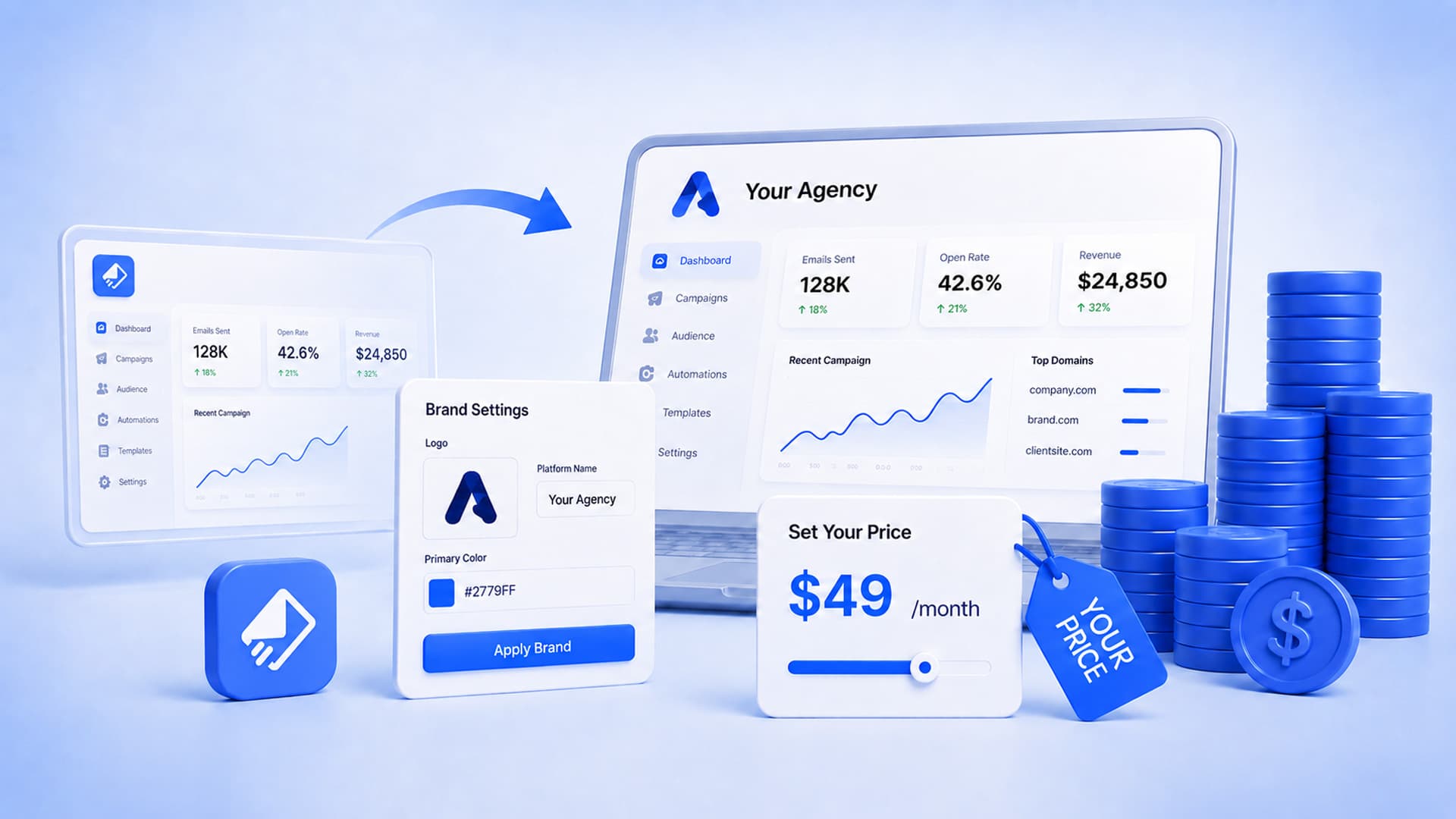
Getting white label email marketing pricing right comes down to two numbers: your cost and your price. If your white label email cost is a flat platform fee plus low per-email sending (for example, your own Amazon SES), your cost stays roughly fixed while you charge each client a monthly rate — so every client you add widens your margin. Most resellers land on a simple monthly retainer per client, tiered by volume and how much you manage. Get the cost structure right and healthy white label email margins follow naturally.
The hardest part of reselling email isn’t the technology — a good white label email marketing platform handles that white label email marketing pricing. It’s answering the question that stalls everyone at the start: “what do I actually charge?” Price too low and you’re doing unpaid infrastructure management; price without understanding your cost and you can’t scale. Let’s fix that with a clear way to think about it. (If you’re still deciding whether to start, our guide on starting a white-label email business covers the setup.)
Start with your cost structure
You can’t price until you know your cost, and this is exactly where the platform you pick changes everything. There are two cost models underneath white-label email:
| Underlying model | How cost behaves | Effect on your margin |
|---|---|---|
| Per-contact pricing | Rises with every client’s list growth | Margin shrinks as clients succeed |
| Flat fee + your own SES | Stays roughly flat; SES is cents per thousand | Margin grows as you add clients |
This is the whole game. If your cost climbs with volume, you’re constantly re-negotiating to protect your margin. If your cost is flat, growth is pure upside. That’s why the resell email marketing pricing that works is almost always built on a flat-cost foundation.
The pricing models that work
Once your cost is flat and low, pick how you package it. Three models cover most resellers:
- Monthly retainer per client — the simplest and most common. A flat monthly fee per client for access plus a level of service. Easy to sell, predictable revenue.
- Tiered by volume/features — Starter / Growth / Pro tiers based on sending volume, number of automations, or hands-on management. Lets clients self-select and grow with you.
- Managed service — you run the campaigns end to end and price for the outcome, not the tool. The highest margin, because you’re selling results, not access.
An illustrative margin example
Numbers here are illustrative — use them as a framework, not market rates — but they show the dynamic. Say your platform costs a flat monthly fee, and SES sending for a mid-size client is a few dollars a month. If you charge that client a monthly retainer, your gross margin per client is high and, crucially, it improves with each additional client because your platform fee is spread across more accounts:
| 1 client | 5 clients | 15 clients | |
|---|---|---|---|
| Your cost per client | Highest (fee not yet spread) | Lower | Lowest |
| Your margin per client | Good | Better | Best |
The reason flat-cost white-label is worth doing: your margin isn’t fixed, it compounds. Each client makes the next one more profitable, which is the opposite of per-contact pricing, where each client’s growth eats your margin.
What to include at each tier
Price the value, not the feature list. Lower tiers might include the branded platform, templates, and self-serve sending; higher tiers add managed campaigns, strategy, deliverability monitoring, and priority support. Because your platform gives every client isolated reputation and true white-label regardless of tier, your differentiation is service and outcomes — which is exactly what clients are happy to pay more for.
Common pricing mistakes to avoid
- Charging cost-plus-a-little. You’re selling a managed, branded product, not reselling access at a small markup.
- Building on per-contact pricing. It caps your margin and punishes you for client growth.
- One-size-fits-all. A single price forces small clients out and leaves money on the table with big ones.
- Forgetting your time. If you manage campaigns, price for the hours, not just the software.
The cost structure that makes margins work
EmailSendX gives resellers a flat platform fee plus your own low-cost SES sending — so your cost stays flat while you charge per client, and every client you add improves your margin. True white-label and isolated reputation on every tier.
Frequently asked questions
How should I price white-label email marketing?
Most resellers charge a monthly retainer per client, tiered by volume and how much they manage. The key is a flat, low underlying cost (a platform fee plus your own SES) so your margin grows as you add clients.
What does white-label email actually cost me?
On a flat-fee-plus-SES model, your cost is the platform’s flat fee plus cents-per-thousand SES sending — roughly fixed regardless of how much your clients grow, which is what makes the margins work.
What margin can a white-label email reseller make?
It varies by packaging and service level, but with a flat cost base the margin compounds: each additional client spreads your fixed cost further, so per-client profit improves as you scale.
Should I charge per contact like the big tools?
Generally no. Per-contact pricing caps your margin and penalizes client growth. A flat retainer (or tiers) on a flat-cost platform is more profitable and easier to sell.
Ready to try it?