On this page(7)
How to start a white-label email marketing business
To start a white label email marketing reseller business, you rebrand an existing email platform as your own, set your own pricing, and sell it to clients as if you built it. The five steps: pick a genuinely white-label platform, brand every touchpoint, isolate each client’s reputation, price for healthy margins, and onboard clients under your name. Done right, a white label email marketing business turns email from a service you mark up into a product you own.
Most agencies stumble into email the same way. A client asks for newsletters, you spin up an account on some big tool, you do great work — and then the client notices the vendor’s logo on the unsubscribe page and quietly realizes they’re paying you to operate software they could rent themselves. In that moment, your premium service becomes a markup. White-label fixes that, and it can become a real revenue line. Here’s how to build one, step by step. Get the real white label email marketing reseller.
Step 1: Choose a genuinely white-label platform
This is where most white label email marketing agency plans quietly fail. Plenty of tools let you upload a logo and call themselves “white-label,” but their brand still leaks in the places clients actually look. Before you build a business on a platform, confirm it brands every touchpoint — the sending domain, the dashboard, the reports, and especially the unsubscribe page. If the vendor’s name appears anywhere a client can see it, it isn’t truly white-label, and your positioning collapses the first time someone clicks “unsubscribe.”
Step 2: Brand every touchpoint as your own
Once you have the right platform, make it yours. Set up client-facing branding across the board:
| Touchpoint | What to brand |
|---|---|
| Sending domain | Each client sends from their own domain, authenticated per brand |
| Dashboard & login | Your colors and your own subdomain — clients never see the vendor |
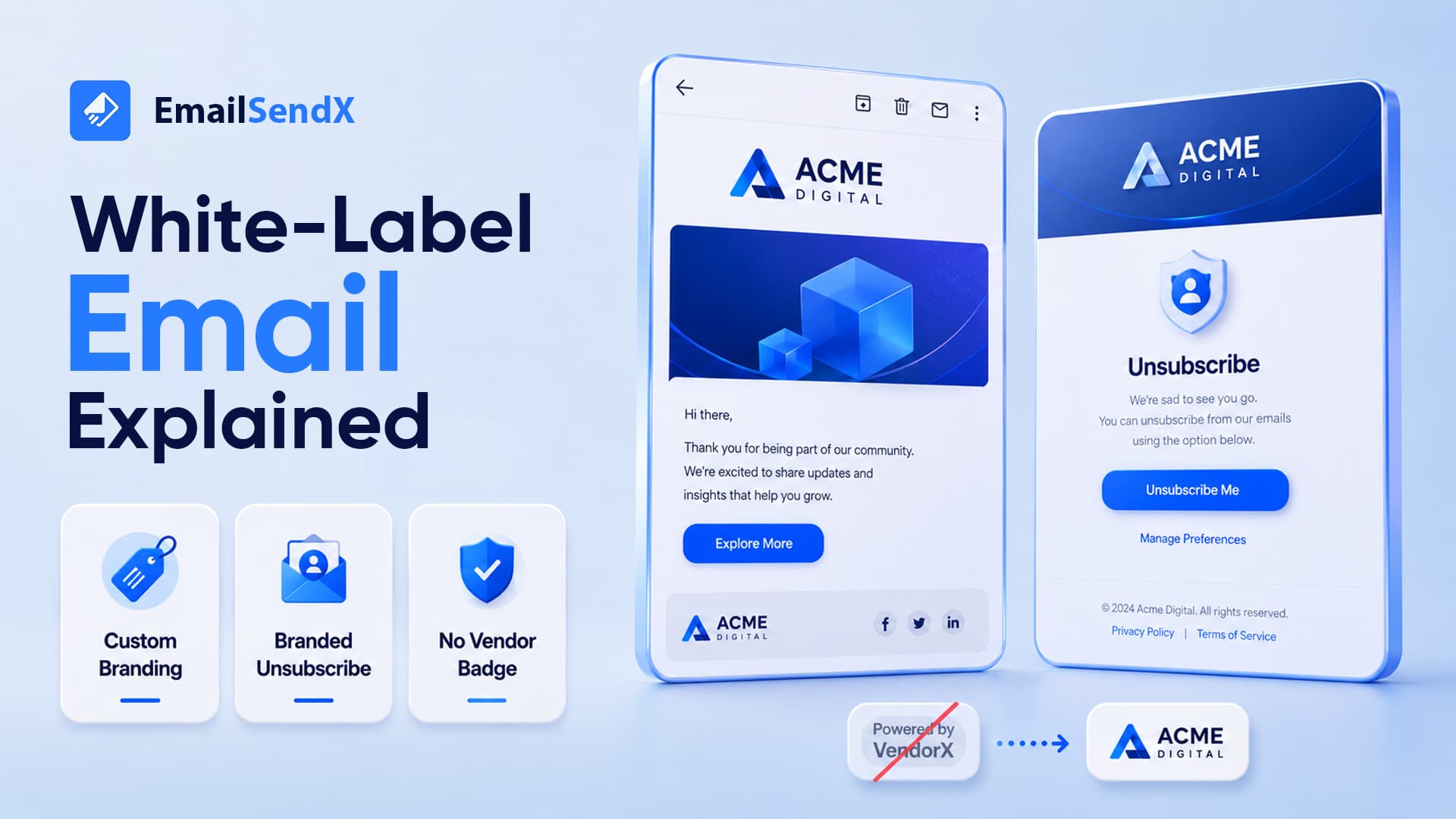
| Unsubscribe page | Fully branded to the client, no vendor footer |
| Reports | Your logo on everything you hand over |
Step 3: Isolate each client’s reputation
This is the operational key to running more than one or two clients. If everyone shares a sending reputation, one client’s bad list can put all of your clients in spam overnight. A platform with isolated workspaces — separate domains, separate authentication, separate reputation per client — keeps one client’s mistake from becoming everyone’s emergency. It’s the difference between a side hustle and a business you can scale.
The moment you have three or more clients, isolation stops being optional. Shared reputation is a single point of failure that can take down your whole book of business in 48 hours.
Step 4: Price it for real margins
Here’s what makes a white label email marketing software business genuinely profitable rather than a break-even favor: the cost structure. If you’re paying per-contact pricing underneath, your margin shrinks as your clients grow. But if the platform runs on a flat fee plus low per-email costs (for example, on your own Amazon SES), your cost stays roughly flat while you charge per client — so every client you add improves your margin instead of eroding it. We cover exactly what to charge in our companion guide to white-label email pricing; the headline is that flat, low underlying cost is what lets you build a business, not just a service.
Step 5: Package, onboard, and sell
Turn it into an offer. Decide whether you’ll resell email marketing as a standalone product, bundle it into retainers, or offer tiers (managed vs self-serve). Build a simple onboarding flow — connect the client’s domain, set up authentication, import and validate their list, load a few templates — and you have a repeatable product you can sell again and again. Because clients are using your branded platform, switching away means leaving your system, which quietly improves retention too.
Why this beats reselling someone else’s tool
The reseller-with-a-markup model is fragile: the client can find the underlying tool, price-shop it, and cut you out. The white-label-product model is durable. You own the relationship, the branding, and the pricing, and the economics improve as you grow. You stop being a middleman and become a software business with the delivery expertise to back it up.
The platform to build your email business on
EmailSendX gives resellers and agencies true white-label email — per-client domains, isolated workspaces, your branding on every touchpoint (including the unsubscribe page), and bring-your-own-SES economics that keep your margin healthy as you add clients.
Frequently asked questions
What is a white-label email marketing reseller?
A business that rebrands an existing email platform as its own, sets its own pricing, and sells it to clients under its own name — branding every touchpoint so the underlying vendor stays invisible.
How much can you charge for white-label email marketing?
It depends on packaging and whether you manage campaigns or offer self-serve. The key is keeping your underlying cost low and flat (e.g., a flat platform fee on your own SES) so your margin grows as clients scale. See our white-label pricing guide for specifics.
Do I need technical skills to start?
Not deep ones. A good white-label platform handles domains, authentication, and deliverability for you. Your value is branding, onboarding, and campaign expertise, not running servers.
How do I stop one client from hurting another’s deliverability?
Use a platform with isolated workspaces so each client has their own domain, authentication, and reputation. That way one client’s bad list can’t affect the others.
Ready to try it?