On this page(8)
The AI Email Boom Is Over. The AI Email Standard Just Started.
In 2023, AI in email marketing was a novelty. By 2024 it was a feature. By 2026 it’s table stakes, and the actual differentiator has shifted: not whether you use AI, but how well you brief it.
The marketers who get 11% better subject-line performance from AI are doing one thing differently from the ones who get worse: they’re feeding it brand-voice context and rejecting generic output. The rest treat AI like a magic 8-ball and get magic 8-ball results.
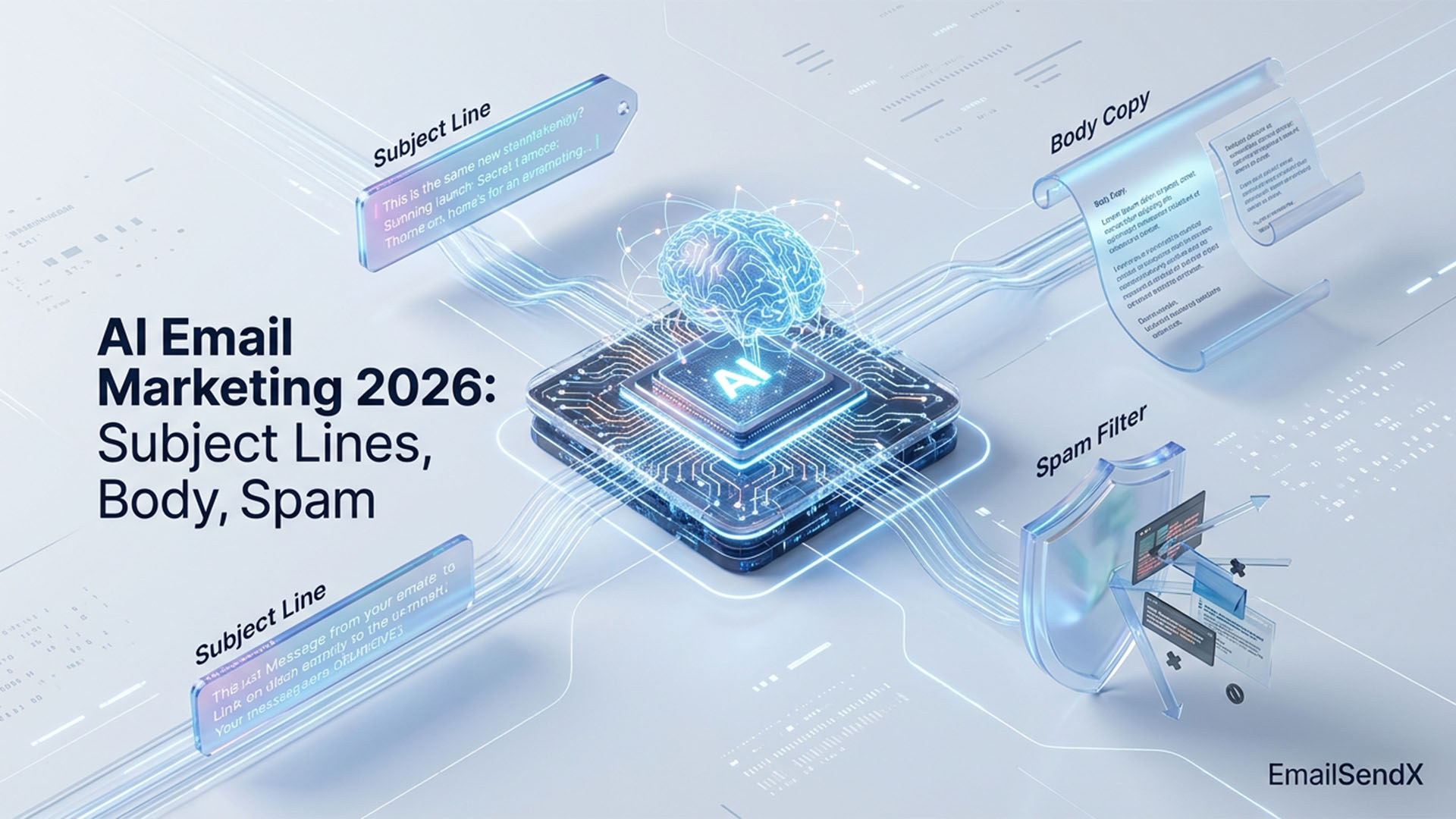
This is the 2026 guide to AI email marketing — the three places AI now genuinely wins, the brand-voice tuning that beats raw GPT, and the AI features still not worth using.
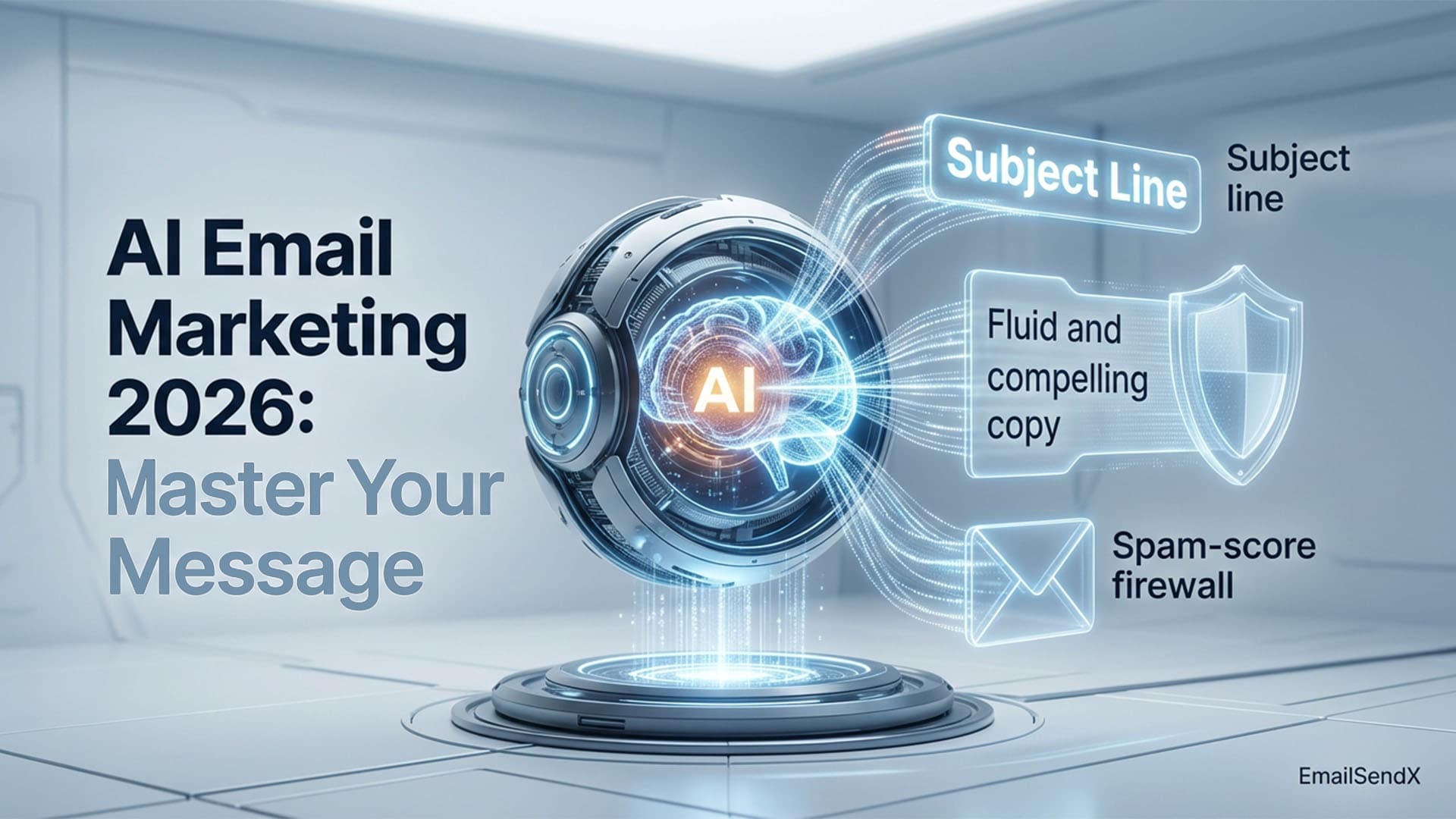
The honest split: AI is better than the average human at three specific email tasks (subject line variant generation, body copy expansion, pre-send spam-score prediction). It is worse than a thoughtful operator at strategy, audience segmentation, and creative direction. Most marketers reverse this.
Where AI in Email Was in 2024 (and Why That Doesn’t Matter Anymore)
The 2024 AI email pitch was “generate a campaign in one click.” The results were uniformly mediocre — generic subject lines, body copy with no point of view, CTAs that read like LinkedIn boilerplate. The novelty wore off by Q2 2025.
What replaced it: AI-as-component, not AI-as-replacement. The 2026 version is a brand-voice-aware composer that generates 5–10 ranked variants for human selection, plus a spam-score predictor that flags problems before send. Used this way, AI is 30–40% faster than manual writing with the same output quality.
The Three Things AI Now Genuinely Does Better Than Humans
1. Subject line variant generation at scale
The cognitive load of writing 8 subject line variants for an A/B test is significant. AI does it in 2 seconds. With a brand-voice-tuned prompt, the top 3 variants typically match or beat human baseline.
2. Body copy expansion from brief
You have a 50-word brief and a 400-word target. AI expands faster than a human, and the expansion is closer to the brief than human freehand writing tends to be.
3. Pre-send spam-score prediction
AI models trained on real spam-folder data can predict deliverability problems before send with 85%+ accuracy — flagging risky phrases, missing unsubscribe headers, tracking-domain mismatches, and over-bolded text. Faster and more thorough than manual review.
The Brand-Voice Tuning Trick That Beats Raw GPT by 11%
Phrasee’s 2026 study compared raw AI output to brand-voice-tuned AI across 1.2 million subject lines. Brand-voice-tuned won 11% higher open rates on average.
The trick is feeding the model three things before generation:
- 5–10 examples of your past best-performing emails. Subject lines + opens + CTRs. The model learns your style empirically.
- A “words we don’t use” list. Generic SaaS hype (revolutionary, game-changing, unlock), forced urgency (last chance, don’t miss), false intimacy (hey there).
- Audience context. Who’s reading this and what do they care about right now? “Agency owners managing 10+ clients” produces different output than “marketers.”
What AI Still Can’t Do (and Probably Won’t Soon)
- Decide what to send. Campaign strategy, message-market fit, segmentation logic — still human.
- Read your audience’s mood. A subject line that crushed last Tuesday may flop today because of news context. Humans catch this, AI doesn’t.
- Write the contrarian take. AI defaults to the median. The opinion that wins inbox attention is the one that’s slightly contrarian to the median — which AI struggles to produce.
- Pick the winning variant from A/B results in low data. Statistical significance under 1000 sends is a human judgment call.
The honest test
Show 10 of your past emails to AI. Ask it to generate 5 more in your voice. If you can’t tell which 5 are yours and which are AI’s after a week, your brand voice is too generic — not that AI is too good.
Where to Plug AI Into Your Email Stack
| Step | AI role | Human role |
|---|---|---|
| Campaign strategy | None | Full |
| Subject line drafting | Generate 5–10 variants | Pick + edit |
| Body copy from brief | Expand brief into draft | Edit voice + facts |
| Pre-send check | Spam-score, link validity, missing headers | Review flagged items |
| Send-time optimization | Recommend per-recipient | Approve schedule |
| Variant selection (A/B) | Surface early signals | Call the winner |
Quick-start prompt template
Write 8 subject lines for [campaign topic]. Audience: [audience description]. Tone: [tone, e.g., confident, slightly contrarian]. Length: under 55 characters. Avoid: generic SaaS hype, forced urgency, hey-there openers. Format: ranked list with one-sentence rationale for each.
How EmailSendX Bakes AI Into the Workflow
EmailSendX’s AI assistant lives inside the composer — no separate AI tool, no copy-paste loop. Every plan includes monthly AI credits (10 on Hobby, 100 on Starter, 500 on Pro, 2,000 on Business; Starter signups also get 500 one-time bonus credits to play with).
- Subject composer: generates 3–10 ranked variants from your brief, tuned to your past winners.
- Body composer: expand a paragraph, rewrite with a different tone, repurpose a winning campaign.
- Spam-score check: flags risky words, broken links, missing unsubscribe, tracking-domain gaps before send.
- Brand voice memory: stores your past winners per workspace so the AI learns each client’s voice separately.
EmailSendX’s AI assistant is included on every plan — brand-voice-tuned, ranked, ready.
Try EmailSendX free →
FAQ: AI Email Marketing
Is AI-written email still flagged as spam by Gmail?
No — Gmail filters based on engagement signals, not authorship. But generic AI patterns (every sentence the same length, no point of view) do correlate with lower opens, which over time hurt reputation.
Can readers tell if an email was AI-written?
Stanford’s 2026 study found 87% of marketers can’t reliably distinguish brand-voice-tuned AI from human writing. Raw AI output is easier to spot.
Should I disclose that emails are AI-assisted?
No legal requirement in any major jurisdiction. Ethically: most readers don’t care if a human reviewed and approved the final draft, which you should always do.
What’s the best AI tool for email subject lines in 2026?
Native AI inside your sending platform (like EmailSendX’s composer) beats standalone tools because it learns your voice from your actual sends. Phrasee and Persado are strong standalone options for enterprise.
How many AI credits do I actually need per month?
Most operators land at 100–300 credits/month: 5–10 campaigns × 10–15 generations each. The EmailSendX Pro plan’s 500 credits covers that comfortably.
Ready to try it?