On this page(9)
A Cold IP Has Zero Reputation. Here’s How to Build It in 30 Days — Without Tanking Deliverability.
A new email sending IP starts at zero reputation. Gmail, Yahoo, and Microsoft don’t know you. Send too much too fast and they’ll throttle you for weeks. Send too slow and your team loses patience and starts pushing volume against your IP’s readiness. Either failure mode delays your full sending capacity by 4–8 weeks.
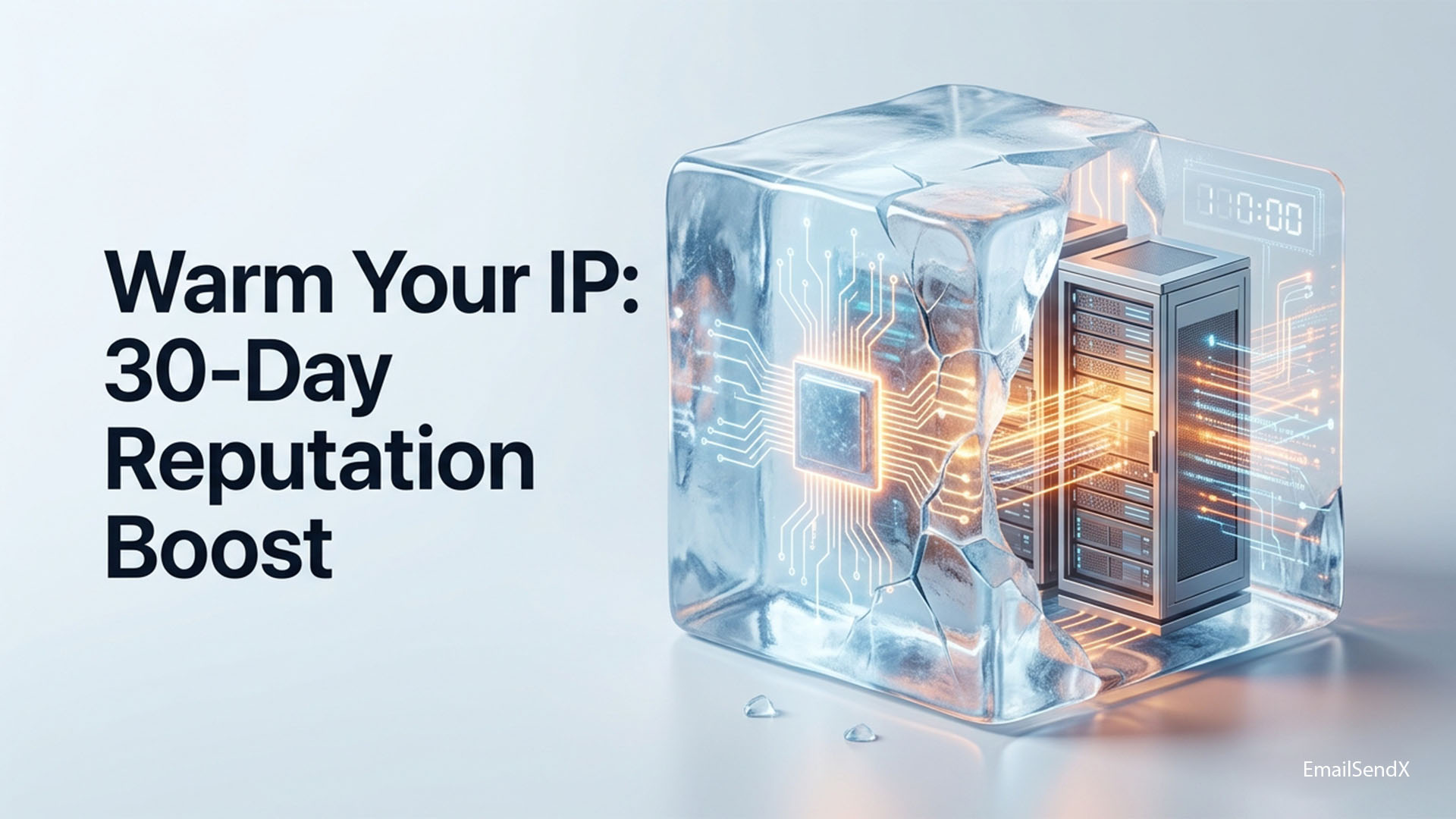
This is the proven email IP warmup plan for 2026 — 30 days from cold IP to full production sending, with daily volume targets, segmentation strategy, monitoring metrics, and the four mistakes that cost most senders an extra month.
The thesis: warmup isn’t about gradually increasing volume. It’s about gradually proving to mailbox providers that the people receiving your mail want it — high open rates, near-zero complaints, near-zero hard bounces. Volume is the byproduct, not the goal.
Before You Start: The Pre-Warmup Checklist
Don’t fire the first send until all six are true:
- SPF, DKIM (RSA-2048), DMARC published on the sending domain.
- DMARC at
p=noneminimum, withruareports flowing. - List hygiene completed — verify emails, remove role addresses, drop dormant addresses.
- Top engagement segment identified — opens in last 30 days.
- Bounce + complaint webhook wired — SNS for SES, equivalent for other providers.
- Suppression list ported from any prior sending platform.
The 30-Day IP Warmup Schedule
| Day | Daily volume | Segment | Cumulative | Watch |
|---|---|---|---|---|
| 1 | 50 | Top 5% engagement | 50 | Bounce < 1% |
| 2 | 100 | Top 5% | 150 | Open rate > 30% |
| 3 | 500 | Top 10% | 650 | Bounce < 1% |
| 4 | 1,000 | Top 15% | 1,650 | Complaint < 0.05% |
| 5 | 2,500 | Top 25% | 4,150 | Open rate > 25% |
| 7 | 5,000 | Top 30% | ~13k | Bounce < 0.5% |
| 10 | 10,000 | Top 40% | ~38k | No throttle warnings |
| 14 | 25,000 | Top 50% | ~95k | Reputation “medium” |
| 17 | 50,000 | Top 60% | ~210k | Open rate > 22% |
| 21 | 100,000 | Top 75% | ~440k | Reputation “high” |
| 25 | 200,000 | Top 90% | ~1M | Bounce < 0.5% |
| 30 | Full volume | Full list | 2M+ | Reputation locked |
Treat the schedule as a ceiling, not a floor
If your bounce rate spikes above 1% on day 4, do not send the day-5 volume. Hold at day-4 volume until bounces drop, then resume the schedule. Mailbox providers reward consistency; they punish growth that outpaces engagement.
Segmentation Strategy: Engagement-Based Tiers
The single biggest predictor of warmup success is sending to engaged audiences first. Build five tiers:
- Tier 1 (Top 5%): opened in last 7 days, clicked in last 30.
- Tier 2 (Top 25%): opened in last 30 days.
- Tier 3 (Top 50%): opened in last 90 days.
- Tier 4 (Top 75%): opened in last 180 days.
- Tier 5 (Full list): all valid contacts.
Add tiers progressively. Don’t skip ahead.
What to Send During Warmup
Best content types for warmup sends
- Personalized welcome / re-engagement — high relevance, encourages reply.
- Account update / product news — expected, valued by recipients.
- Educational digest — high-value content, lower commercial pressure.
Avoid during warmup
- Promotional / discount-heavy content.
- Long subject lines or excessive emoji.
- Re-engaging dormant lists.
- Cold or purchased lists (will tank reputation in 1 send).
One exception worth knowing
If you have a pristine, double-opted-in segment with engagement rates above 50%, you can safely include a single low-stakes promotional element — an exclusive preview, an early-access invite. The engagement signal stays high; the spam triggers stay low.
The Metrics to Monitor Daily
| Metric | Target during warmup | Red line |
|---|---|---|
| Open rate | > 25% | < 18% → pause |
| Click rate | > 2% | < 0.8% → review content |
| Hard bounce | < 0.5% | > 1% → pause + clean list |
| Complaint rate | < 0.05% | > 0.1% → pause immediately |
| SES reputation | “Healthy” | “At Risk” → pause |
| Gmail Postmaster reputation | Medium → High | Low → pause |
The 4 Most Costly Warmup Mistakes
- Sending to the full list on day 7. The most common impatience failure. Every percentage point of bounce or complaint above target costs you 3–5 days of recovery.
- Skipping list hygiene. Old lists have 5–15% invalid addresses. Sending into them on a cold IP is reputation suicide.
- Sending promotional content first. Discount and urgency content trigger spam filters more aggressively. Lead with value content.
- Ignoring DMARC reports. If
ruashows third-party senders failing alignment, fix it before scaling volume.
How EmailSendX Automates IP Warmup
EmailSendX includes IP warmup curves that schedule sends across the 30-day window automatically. You define the destination volume; the platform paces sends to your engagement tiers, monitors bounce/complaint metrics in real time, and pauses if any threshold is breached.
- Engagement tier auto-segmentation — Tier 1 through Tier 5 calculated daily.
- Reputation dashboard — SES + Gmail Postmaster signals in one view.
- Auto-pause on red lines — sends halt if bounce > 1% or complaint > 0.1%.
- Provider failover — if one IP throttles, sends route to a healthy backup.
EmailSendX paces your IP warmup automatically and pauses on bounce/complaint red lines.
Start free with EmailSendX →
FAQ: Email IP Warmup
Do I need to warm up shared IP pools?
Less aggressively, but yes. Shared pools have a baseline reputation, but introducing a new sender at full volume can still trigger throttling on your domain.
How long until my IP is fully warm?
30 days is standard. Aggressive warmup with a clean, engaged list can finish in 21 days. Conservative or troubled warmups can extend to 45–60 days.
Can I run multiple IPs in parallel during warmup?
Yes — if you have 3 IPs, warm them simultaneously with the same schedule. Don’t mix warmed and cold IPs in the same campaign without rotation logic.
What if my list is small — under 5,000 contacts?
Skip warmup. SES’s shared pool handles low-volume senders well. Move to dedicated IP only when you cross 100k sends/month.
Does domain reputation also need warmup?
Yes — domain reputation is built alongside IP reputation. The schedule above warms both.
Ready to try it?