On this page(8)
Why Most “Drip Campaigns” Are Just Scheduled Newsletters Pretending to Be Sequences
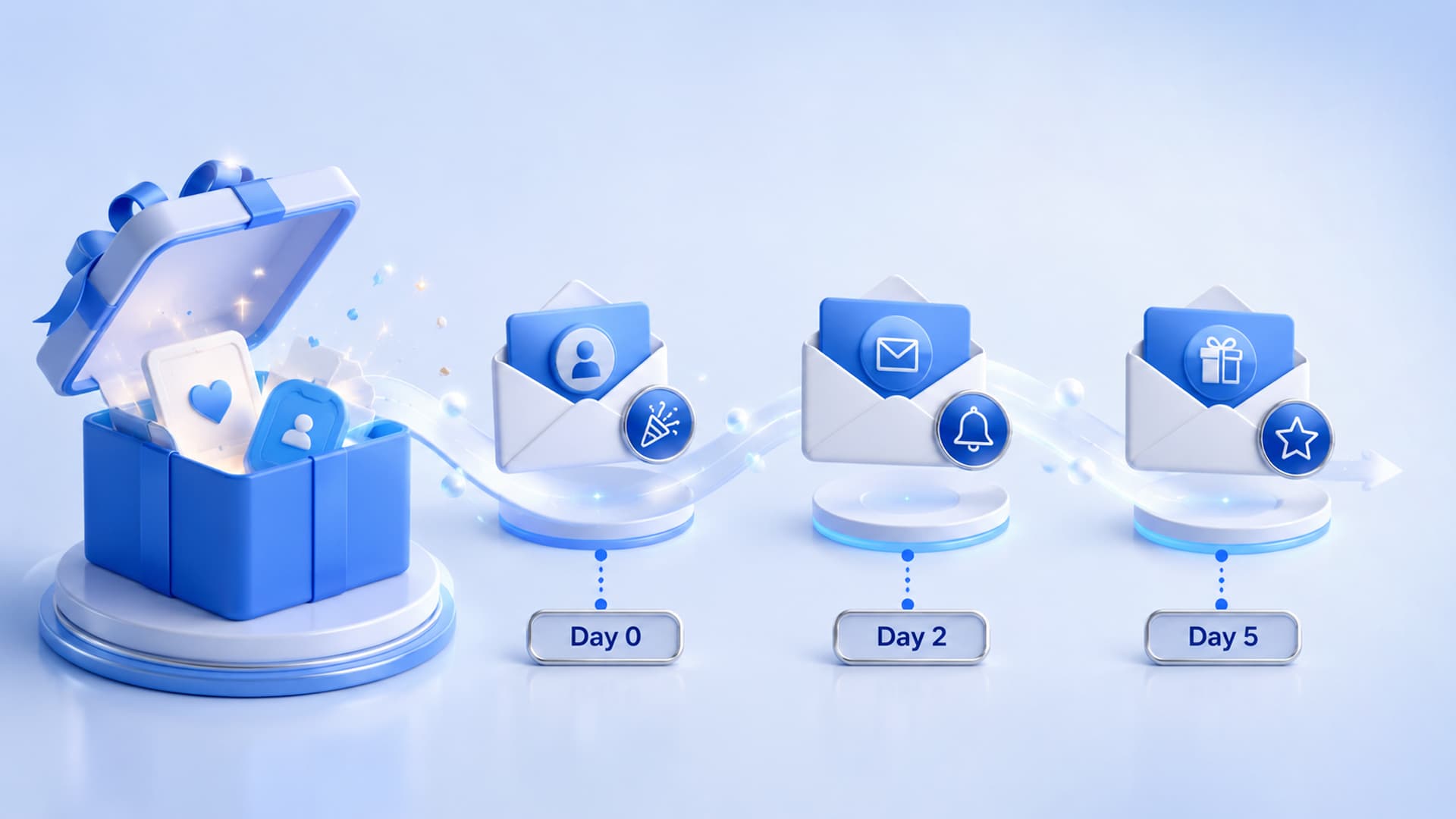
Open any marketing blog and search “drip campaign.” You’ll find dozens of templates that all look the same: Email 1 on day 0, Email 2 on day 3, Email 3 on day 7, ending with “Email 5: Make the pitch.” That’s not a drip campaign. That’s a newsletter on a delay.
A real drip campaign branches. It reacts. It exits people who’ve already converted, accelerates engaged subscribers, and pauses cold ones. Also, it is, structurally, a tree — not a schedule.
This is the 2026 playbook for building email drip campaigns that actually convert — with the five required components, a real example with numbers, and the five mistakes that turn a drip into a newsletter.
Definition that matters: A drip campaign is a behaviorally-triggered, branching email sequence with conditional logic, smart timing, and explicit exit ramps. If your “drip” is a linear schedule with no branches, it’s a newsletter.
What a Real Drip Campaign Is (and Isn’t)
| Element | Real drip | Newsletter on a delay |
|---|---|---|
| Entry trigger | Behavioral event | List add |
| Timing between emails | Dynamic, based on engagement | Fixed schedule |
| Branches | Multiple paths | Linear |
| Exit conditions | Multiple (purchase, unsubscribe, inactivity) | End of schedule |
| Content per branch | Different | Same |
| Goal | Behavior | Awareness |
The 5 Required Components of a Real Drip
- An entry trigger that fires on behavior — signup, abandoned cart, demo no-show, content download, lifecycle event. Not just a list add.
- A primary path — 3–7 emails that progress logically toward conversion.
- Engagement branches — opens, clicks, replies route to different next-steps.
- Exit ramps — on conversion (remove from drip), unsubscribe (suppress), or sustained inactivity (move to cold list).
- Re-entry rules — if they bounce off the path but come back later, how do they re-enter?
Example: A Drip That Converted 14.2% (Real Numbers)
EmailSendX onboarding drip, post-signup, for users who connect a sending provider but don’t send a campaign in 48 hours:
| Step | Trigger | Content | Branch |
|---|---|---|---|
| 1 | +48h no campaign sent | “You connected SES. Here’s the 5-min first-campaign guide.” | Open → step 2A. No open → step 2B (3 days later). |
| 2A | +24h after open | One-page playbook: 3 templates ready to fork. | Click any template → step 3. No click → step 2B. |
| 2B | +72h after no open | Plain-text personal note: “Stuck on setup? Reply with where you’re at.” | Reply → human handoff. No reply → step 4 (cold). |
| 3 | +24h after template click | How to A/B test your first send. | Send campaign → exit drip + enter activation drip. |
| 4 | +7d cold | One last value email, then suppress. | End of drip. |
Conversion rate (entered drip → sent first campaign within 14 days): 14.2%. Baseline without the drip: 4.6%. The branching adds 9.6 percentage points to conversion — not the schedule.
The 5 Drip Campaign Mistakes That Kill Conversion
- No exit on conversion. Subscribers who’ve already converted keep getting onboarding emails. Looks unprofessional, drives unsubscribes.
- Same email regardless of engagement. A subscriber who opened every email gets the same next email as one who’s never opened. Wasted opportunity.
- Fixed timing for everyone. Active subscribers want faster cadence; cold ones need slower. Same schedule = wrong for both.
- Hard pitch on email 1. The first email establishes the relationship, not the sale. Save the pitch for email 3 or 4.
- No replies considered. If someone replies to a drip email, the drip should pause and a human should respond. Most drips ignore replies entirely.
How to time the gaps between emails
Rule of thumb: shorter gaps after high engagement (open + click within 2 hours → next email within 24 hours). Longer gaps after low engagement (no open in 3 days → next email at 5 days, lower-stakes content).
What to do when subscribers go cold mid-drip
Don’t just keep sending. Switch to a “break glass in case of emergency” email — plain-text, from a real person’s address, no marketing copy. Ask one question: “What’s blocking you?” A meaningful percentage will reply and become qualified leads. The rest get suppressed cleanly.
The 4 Drip Campaigns Every Agency Should Run for Clients
- Welcome drip. 5–7 emails over 14 days. New subscribers → brand intro → product fit → soft pitch.
- Abandoned-action drip. Cart abandon, demo no-show, signup-no-activation. 2–3 emails, short cadence.
- Re-engagement drip. Subscribers dormant 60+ days. 3 emails to either revive or suppress.
- Post-purchase drip. Onboarding, education, cross-sell. 4–6 emails over 30–60 days.
How EmailSendX Builds Drip Campaigns
EmailSendX’s automation engine is built around the tree, not the schedule. You drag-and-drop branches, conditions, and exit ramps. Every trigger is behavior-aware.
- Visual branching builder with delays, conditions, A/B splits.
- Behavioral triggers on opens, clicks, replies, custom events, deal-stage changes.
- Exit on conversion — native trigger to remove from drip on purchase or other event.
- Reply detection — pause drip when subscriber replies, surface to 1:1 inbox.
- Drip analytics — conversion at each step, drop-off identification.
EmailSendX’s automation builder handles trees, not just schedules — from $0/mo.
Try EmailSendX free →
FAQ: Email Drip Campaigns
How long should a drip campaign be?
3–7 emails for welcome and onboarding. 2–3 for abandoned-action. The right length is shorter than you think — conversion typically peaks at email 3 or 4.
What’s a good open rate for drip emails?
50%+ on email 1 (warm audience just signed up). Declining to 25–30% by email 5. If email 2 drops below 40%, your subject lines or content needs work.
Should drip emails be personalized?
Real personalization (referencing what they did) yes. Token personalization (first name in subject) no.
Can I run a drip campaign without paying for marketing automation?
Possible with hand-coded triggers via API, but operationally fragile. Even EmailSendX’s free plan includes automation — there’s no reason to roll your own anymore.
What converts better: long drips or short drips?
Short drips with branching almost always beat long linear drips. The branching catches the engaged early; the brevity preserves goodwill with the disengaged.
Ready to try it?