On this page(8)
Amazon SES vs SendGrid: the short answer
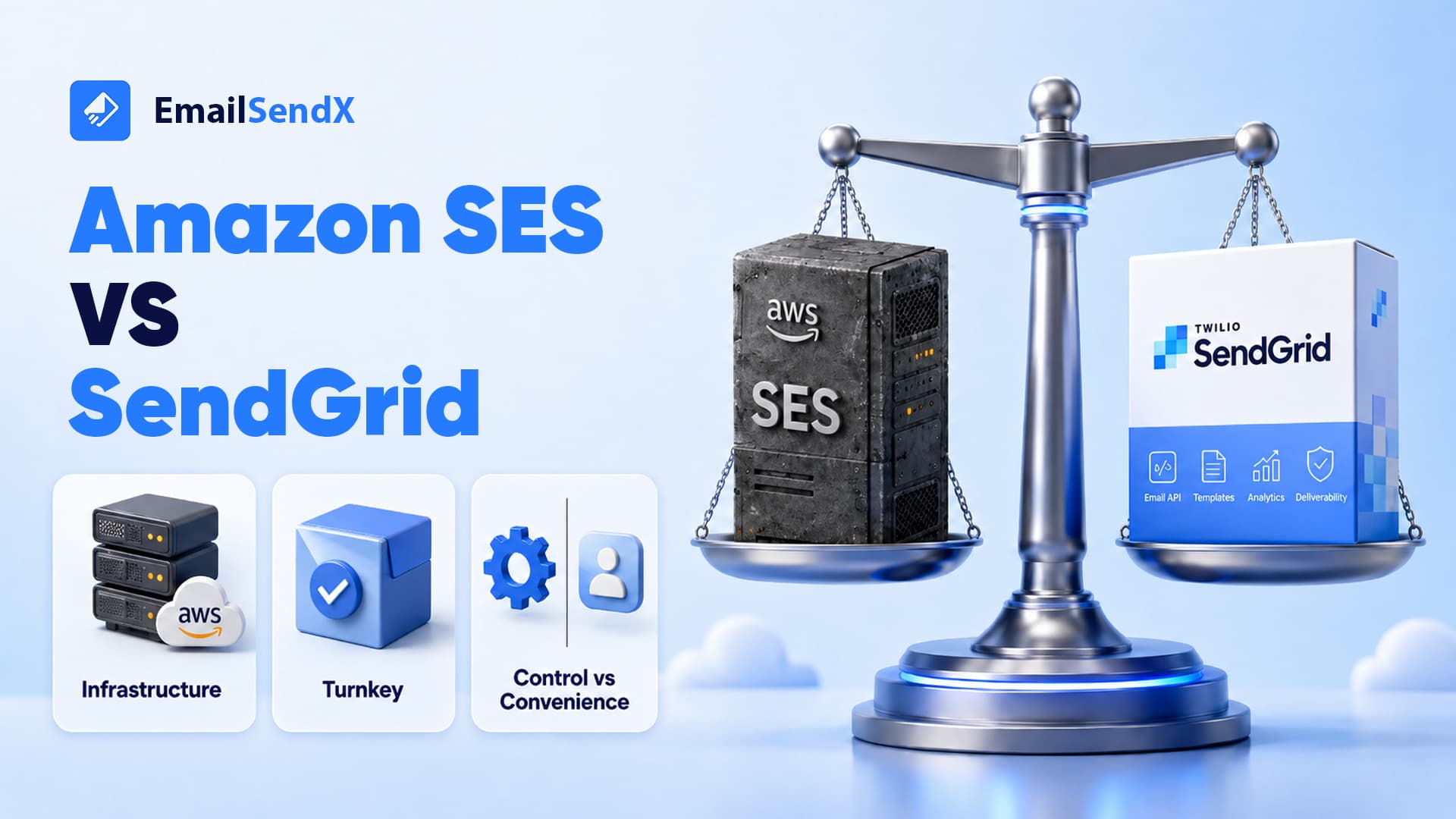
Amazon SES vs SendGrid comes down to one trade-off: raw and cheap versus turnkey and convenient. Amazon SES gives you bare-metal sending at a fraction of the price, but you build everything around it. SendGrid hands you a full platform — templates, analytics, a friendly dashboard — for volume-based pricing that climbs as you grow. Pick SES if you have engineering time and want the lowest cost; pick SendGrid if you want it working this afternoon. (There’s also a third option that gives you both, more on that below.)
Here’s the scene almost every founder hits eventually. Your app needs to send email — receipts, password resets, the occasional campaign. You open two tabs. One is Amazon SES, promising to send a thousand emails for pennies. The other is SendGrid, promising you’ll be live in ten minutes. Both are telling the truth. The catch is what they leave out.
Let’s settle the amazon ses vs sendgrid question honestly, the way a colleague would explain it — not a sales page.
The core difference, in one breath
Amazon SES is an API and an SMTP relay. It does one thing brilliantly: hand it a message and it sends it, cheaply and reliably, on AWS’s infrastructure. What it doesn’t give you is a campaign builder, contact management, nice analytics, or hand-holding. You bring those.
SendGrid is a platform. It wraps sending in templates, suppression lists, a dashboard, and onboarding so a non-engineer can run with it. You pay for that convenience, and the bill is tied to how much you send.
Amazon SES vs SendGrid, side by side
| Factor | Amazon SES | SendGrid |
|---|---|---|
| What it is | Raw sending API / SMTP relay | Full sending platform |
| Pricing shape | Very low per-email (AWS rates) | Tiered, scales with volume |
| Ease of setup | Steeper — AWS console, IAM, warmup | Fast — live in minutes |
| Dashboard & analytics | Minimal (build your own) | Rich, built in |
| Templates & contacts | None — you provide | Included |
| Deliverability | Strong, but you manage reputation | Strong, but with managed tooling |
| Best for | Engineering teams optimizing cost | Teams wanting turnkey simplicity |
Pricing and limits change often — check each provider’s current page before deciding. This compares the models, not exact 2026 numbers.
The hidden cost nobody mentions
When people search ses vs sendgrid pricing, they compare the sticker prices and SES wins by a mile. But the real comparison is total cost. With SES, the “cheap” sending comes with a bill paid in engineering time: you wire up the API, manage bounces and complaints, build reporting, handle suppression, and warm your own IP. With SendGrid, you pay more per email but skip that work.
The honest way to read sendgrid vs amazon ses: SES is cheaper in dollars, SendGrid is cheaper in hours. Which one wins depends on whether your scarce resource is money or engineering time.
Deliverability: roughly a tie
Both can land in the inbox extremely well — SES rides AWS’s strong sending reputation, SendGrid brings years of managed deliverability tooling. As we’ve written before, deliverability is driven far more by your authentication, list hygiene, and reputation than by the logo on the dashboard. Neither platform saves you from a bad list.
The third option: a platform on top of SES
Here’s the part the two-tab comparison misses. You don’t actually have to choose between “cheap but raw” and “easy but pricey.” A growing category — the kind of amazon ses alternative that sits on top of SES rather than replacing it — gives you SES’s per-email cost and a real platform: campaigns, automation, analytics, white-label, and managed deliverability. You bring your own SES; the platform handles everything around it for a flat fee.
That’s exactly how EmailSendX is built, and for teams asking “what’s the best transactional email setup that won’t get expensive at scale?”, it’s often the answer that ends the tab-juggling.
So which should you pick?
| Choose… | If you… |
|---|---|
| Amazon SES (raw) | Have engineering time, want the absolute lowest cost, and don’t need a UI. |
| SendGrid | Want a turnkey platform today and don’t mind volume-based pricing. |
| SES + a platform on top | Want SES economics and campaigns, automation, and white-label — without the build. |
Get SES pricing with a real platform
EmailSendX runs on top of your own Amazon SES — you keep the low per-email cost and get campaigns, automation, deliverability tooling, and white-label on top, for a flat fee. The best of both tabs.
Frequently asked questions
Is Amazon SES cheaper than SendGrid?
In raw per-email price, yes — SES is dramatically cheaper. But SES has no platform, so the savings are partly offset by the engineering time you spend building campaigns, reporting, and deliverability management around it.
Which has better deliverability, SES or SendGrid?
Both can deliver excellently. Deliverability depends mostly on your authentication, list hygiene, and sender reputation rather than the platform itself.
What’s a good Amazon SES alternative?
If you like SES’s pricing but want a real platform, consider a tool that runs on top of SES (like EmailSendX) rather than a full replacement — you keep the low cost and gain campaigns, automation, and white-label.
Is SES or SendGrid better for transactional email?
Both handle transactional email well. SES is favored by cost-sensitive engineering teams; SendGrid by teams wanting turnkey templates and analytics. A platform on top of SES gives you both.
Ready to try it?