On this page(10)
The Email Sender You Pick Today Defines Your Margin for Three Years
Picking an email sender is one of those decisions that looks simple on day one and becomes mission-critical six months in. Pick the wrong one and you’re either bleeding money on resold AWS infrastructure, fighting reputation issues on shared IPs you don’t control, or waiting 48 hours for support tickets while a transactional system is silently dropping receipts.
This is the 2026 buyer’s guide to Amazon SES vs SendGrid vs Mailgun vs Postmark — the four senders that handle the vast majority of programmatic email volume on the internet. We compare pricing, deliverability, API quality, support, and the sneaky details that don’t show up in a marketing comparison page. Read the full comparison of Amazon SES vs SendGrid vs Mailgun vs Postmark.
TL;DR: Amazon SES is the cheapest by 30× but requires AWS savvy. Postmark wins on deliverability and DX for transactional. SendGrid wins on volume scale + integrations. Mailgun wins on flexible APIs and EU-region sending. The right answer is usually two of them — one primary, one failover.
The 30-Second Verdict
| Provider | Best for | Per 1k emails | Free tier | Deliverability |
|---|---|---|---|---|
| Amazon SES | Cost-conscious senders, agencies, BYOS platforms | $0.10 | 62k/mo from EC2 | Excellent (your IPs) |
| SendGrid | High-volume mixed transactional + marketing | $0.85+ | 100/day | Good |
| Mailgun | Developer-flexible, EU residency, multi-region | $0.80+ | 5k/mo (3 mo) | Good |
| Postmark | Transactional, deliverability-critical sends | $1.25+ | 100/mo | Best-in-class |

1. Amazon SES — The Infrastructure Layer
SES is the foundation that nearly every other provider on this list either resells, mirrors, or competes against. AWS owns the entire pipe, runs it at infrastructure cost, and prices it accordingly: $0.10 per 1,000 emails. There’s no monthly minimum, no contact-based tax, no “essentials vs pro” tier shuffle.
Strengths
- Cheapest sender on the planet at scale.
- Multiple regions (us-east-1, eu-west-1, ap-southeast-2, etc.) for data residency.
- Dedicated IPs available ($24.95/mo each) with full warmup control.
- Native AWS integration: SNS for events, IAM for security, CloudWatch for metrics.
Weaknesses
- AWS console is hostile to non-engineers.
- Sandbox by default — you must request production access.
- No built-in dashboard for marketers.
- Support is AWS-tier (i.e., basic unless you pay for Business support).
2. SendGrid — The Volume Workhorse
Twilio SendGrid is the largest email sender by volume. It powers a significant chunk of internet email and excels at high-throughput, mixed transactional + marketing workloads. The trade-off: pricing is opaque, the “Email API” and “Marketing Campaigns” are essentially separate products with separate pricing, and shared IP deliverability is a known concern at lower tiers.
Strengths
- Battle-tested at billions-per-month scale.
- Strong integrations with every major framework, language, and platform.
- Decent documentation and a deep template library.
Weaknesses
- Pricing escalates fast at marketing scale.
- Shared IP pools have noticeable deliverability variance.
- Twilio acquisition has shifted product direction toward enterprise plans.
3. Mailgun — The Developer-First Choice
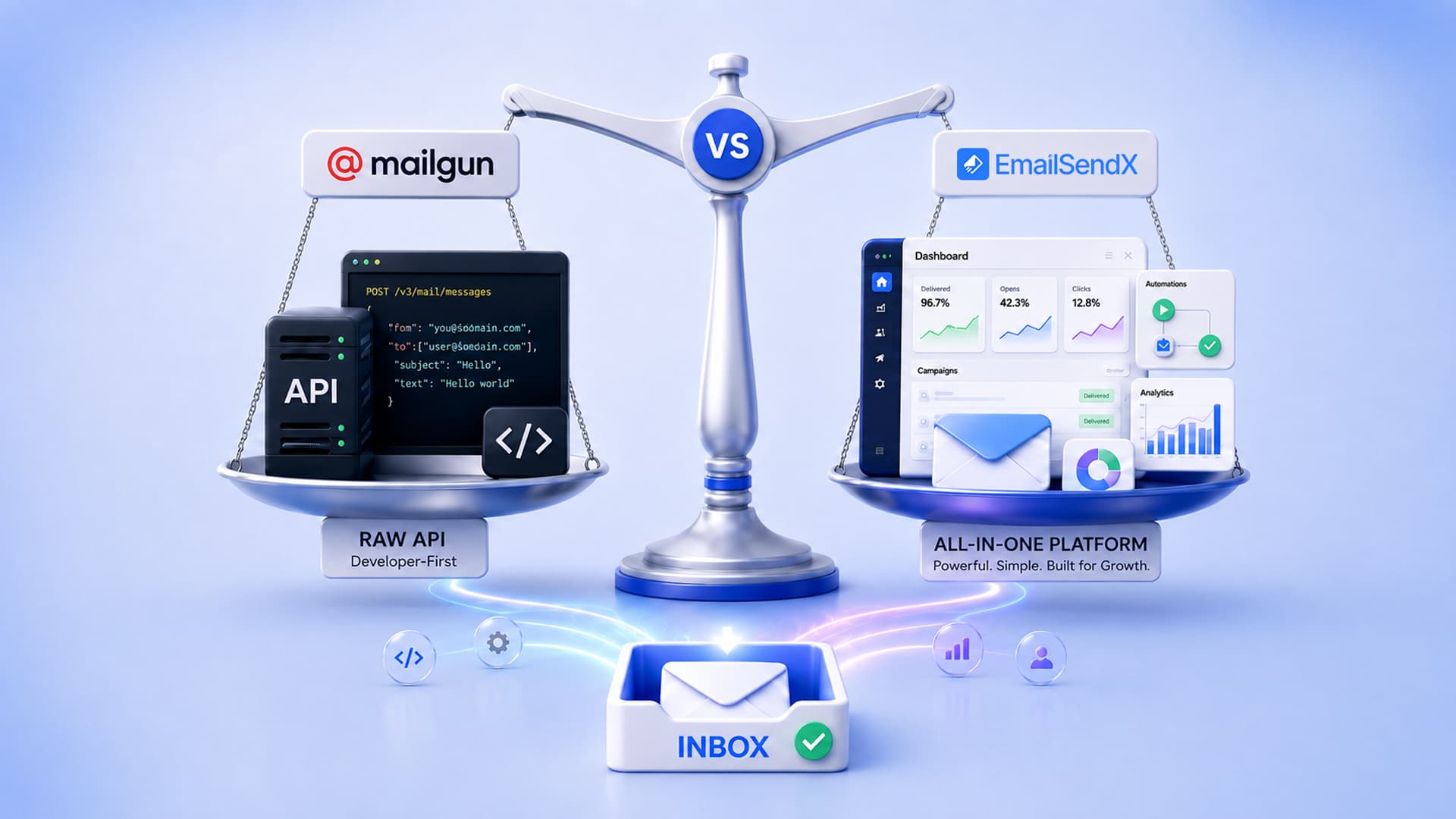
Mailgun (Sinch) is the API-first sender that developers reach for when they want maximum flexibility: routing, parsing inbound email, multi-region delivery, and granular event webhooks. It also has the strongest EU footprint among the four, which matters for GDPR-bound senders.
Strengths
- Cleanest API surface for power users.
- EU region with full data residency.
- Strong inbound parsing and email routing features.
- Granular event tracking with webhook reliability.
Weaknesses
- Per-1k pricing higher than SES.
- Sub-account management more cumbersome than competitors.
- Documentation has rough edges in places.
4. Postmark — The Deliverability Specialist
Postmark made a deliberate bet: they’d be the sender for transactional email only, and they’d guard their IP reputation aggressively to deliver inbox rates the others can’t match. They built separate streams for transactional vs broadcast, refused to onboard cold-email senders, and turned the result into the highest measured inbox placement among the four.
Strengths
- Best-in-class deliverability for transactional email.
- Excellent developer experience and support response time.
- Clean separation of transactional and broadcast streams.
- Real-time bounce + complaint webhooks.
Weaknesses
- More expensive per email than SES or SendGrid.
- Stricter onboarding — rejects edgy use cases.
- Smaller integration footprint.
Pricing Math: 1 Million Emails / Month
| Provider | Plan | Monthly cost | Notes |
|---|---|---|---|
| Amazon SES | Pay-as-you-go | $100 | + $25 dedicated IP if needed |
| SendGrid | Pro 1.5M | ~$249 | Dedicated IP included |
| Mailgun | Foundation | ~$210 | 500k base + overage |
| Postmark | 1M tier | ~$995 | Premium positioning |
The Decision Framework
- Pure transactional, zero tolerance for spam folder? Postmark.
- Highest possible volume at lowest cost, willing to manage AWS? Amazon SES.
- Mixed transactional + marketing, want one provider? SendGrid.
- EU residency or developer-first API surface? Mailgun.
- Agency running 10+ clients? Use a control plane like EmailSendX with all four available, auto-failover between them.
The hidden answer: don’t pick one
The agencies and SaaS companies running mature email programs in 2026 don’t pick one provider. They run SES as primary, Postmark for transactional, and SendGrid or Mailgun as marketing failover. When SES throttles or a domain’s reputation dips, sends route automatically to the backup. The control plane that orchestrates this is what makes BYOS practical at scale.
How EmailSendX Handles All Four Providers
EmailSendX supports Amazon SES, SendGrid, Mailgun, Postmark, plus Brevo, Resend, Gmail, and any SMTP — eight providers total — with auto-failover. You connect each one, set a priority order per workspace, and the platform routes sends through the cheapest available pipe with healthy reputation. If one provider hits a soft limit or your reputation flags, sends transparently fall through to the next.
- Per-workspace provider chains — different priority orders for different clients.
- Reputation-aware routing — bounces and complaints feed back into provider scoring.
- Cost dashboard — see actual spend per provider per workspace.
- Single API surface — your code talks to EmailSendX, not four different vendors.
EmailSendX gives you SES, SendGrid, Mailgun, Postmark, and 4 more in one control plane.
Try EmailSendX free →
FAQ: Amazon SES vs SendGrid vs Mailgun vs Postmark
Is Amazon SES really cheaper than SendGrid?
Yes — about 8–10× cheaper at million-per-month volume. SendGrid resells AWS-grade infrastructure with a marketing dashboard layer; SES is the raw infrastructure.
Does Postmark allow marketing email?
Postmark has a separate Broadcast stream for marketing email, but they vet senders carefully and reject cold-email use cases. Use Postmark for transactional, a different provider for marketing.
Which provider has the best deliverability in 2026?
Postmark, by independent measurement (Mail-Tester, GlockApps). SES is excellent if you warm and manage your IPs. SendGrid and Mailgun on shared IPs vary by pool quality.
Can I switch providers without losing sender reputation?
Domain-level reputation (DKIM-signed) carries forward. IP reputation is per-IP — switching providers means re-warming new IPs. The transition takes 2–4 weeks.
Should I use one provider or multiple?
For mature programs, multiple. EmailSendX supports all 8 in one platform with auto-failover — you stop choosing and start orchestrating.
Ready to try it?